
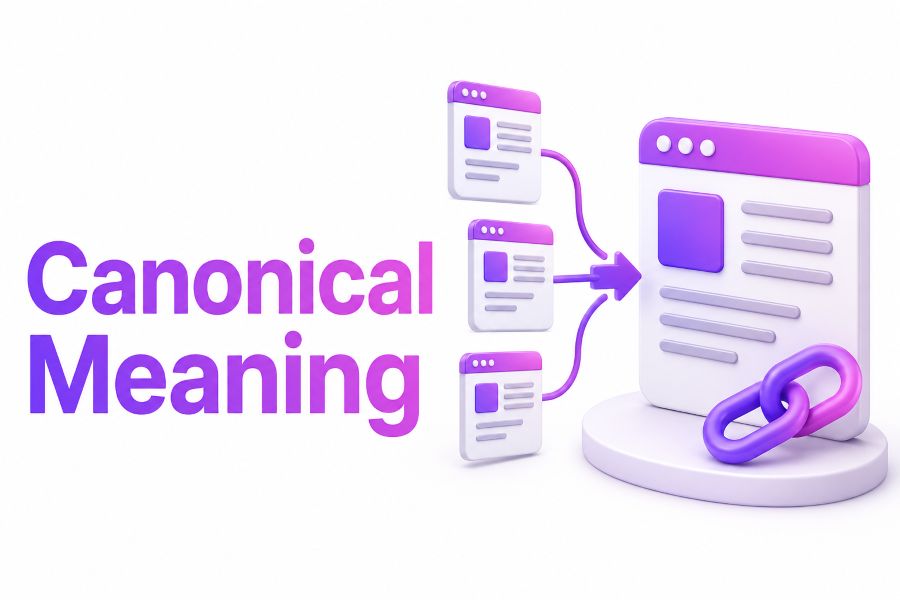
The canonical meaning describes something that is officially accepted, recognized as standard, or considered the most important version within a specific system. The word appears in many fields, including religion, literature, mathematics, technology, and search engine optimization. Although the meaning changes slightly depending on the context, the central idea remains the same: a canonical item represents an approved, trusted, or preferred form. Understanding this term helps you interpret discussions about canonical books, canonical stories, canonical URLs, and canonical forms.
This article explains the meaning of canonical, its history, practical applications, and why the concept matters in modern industries.
What Does Canonical Meaning Represent In Different Contexts?
The canonical meaning refers to something that has earned recognition as an official, accepted, or standard version. A canonical object does not simply exist as another option. It usually represents the version that people, organizations, creators, or systems recognize as authoritative.
The word comes from “canon,” which historically referred to a rule, standard, or collection of accepted works. Over time, the meaning expanded beyond religious discussions and became common in fields where standards and preferred versions matter.
For example, a canonical book in literature is a work considered highly influential and important enough to represent a specific period, movement, or culture. A canonical story in a fictional universe refers to events officially approved by the creators rather than fan-made additions.
The concept also appears in mathematics and technology. In these areas, “canonical” often refers to a standardized form that makes information easier to compare, organize, or process. A canonical representation removes unnecessary differences and creates a consistent structure.
The importance of canonical concepts continues to grow as digital information expands. In 2024, global internet users exceeded 5.3 billion, underscoring the need for systems that organize information accurately. Standardized approaches help search engines, software platforms, and researchers identify reliable information.
A canonical version provides clarity by reducing confusion among multiple alternatives. Whether you are discussing a famous novel, a mathematical equation, or a webpage, the canonical form provides a recognized reference point.
A plagiarism detection process also depends on identifying original and duplicated content accurately. Businesses and writers often use a top plagiarism checker to compare text and determine whether content contains copied sections, which supports the importance of identifying original sources.
Must-know Tip: Experts in information management often emphasize that standards create efficiency. A recognized version allows people and systems to communicate clearly without repeatedly deciding which version should be considered correct.
How Canonical Meaning Developed From History To Modern Usage
The history behind canonical meaning shows how a word connected to rules developed into a broad concept used across modern industries. Originally, canonical was strongly associated with religious authority and official collections of accepted texts.
Religious institutions used the term to identify writings, rules, and practices considered valid according to established traditions. A canonical scripture is a text officially recognized within a religious framework.
The meaning later expanded into literature and culture. Scholars began using canonical to describe works that shaped human knowledge, artistic movements, and social discussions. These works gained recognition because of their influence rather than simply their popularity.
In modern culture, the term became common in entertainment communities. Movies, television shows, video games, and fictional universes often separate official stories from unofficial creations. A storyline approved by the creators becomes canonical, while alternative interpretations remain non-canonical.
Technology further changed how people use the word. Software developers began using canonical to describe standardized data structures and preferred formats. Search engines adopted the concept through canonical URLs, which help identify the main version of a webpage when duplicate pages exist.
The growth of digital content has made canonical systems more important. In 2025, businesses produced and managed larger volumes of online information than ever before, creating challenges around duplication, organization, and accuracy.
The same principle appears in content creation. Writers and marketers need clear sources, consistent information, and trusted references to maintain quality. The idea of canonical information helps users identify which version deserves priority.
Must-know Tip: A concept becomes canonical because a community accepts its authority. Popularity alone does not make something canonical. Recognition, influence, and official approval create canonical status.
Why Canonical Meaning Matters In SEO And Digital Content
The canonical meaning has a major role in search engine optimization because websites often contain multiple pages with similar or identical content. Search engines need a way to understand which page represents the preferred version.
A canonical URL tells search engines which webpage should receive priority when duplicate versions exist. Without proper canonical signals, search engines may struggle to determine which page should appear in search results.
For example, an online store may have several URLs showing the same product because of filters, tracking parameters, or category structures. A canonical tag helps search engines understand the main product page.
This process protects website authority because ranking signals are directed toward the preferred page instead of being divided among duplicates. Google processes billions of searches every day, and clear signals help improve how websites are indexed.
Content creators also benefit from understanding canonical principles. When publishing articles, they should avoid unnecessary duplication and maintain clear ownership of original information.
A strong content strategy depends on creating unique pages that provide real value. Writers who understand AI content writing can use technology responsibly to organize ideas, improve efficiency, and support original content creation without replacing human judgment.
Canonical concepts also apply when websites syndicate content. Publishers should clearly identify the original source to prevent confusion about ownership and relevance.
Must-know Tip: SEO professionals recommend reviewing duplicate pages regularly because website structures change over time. A page that was unique previously can become duplicated after redesigns, migrations, or new publishing systems.
How Canonical Forms Create Order In Mathematics And Technology
In mathematics, the canonical meaning focuses on creating a standard representation from multiple possible options. Many mathematical objects can be expressed in different ways, but a canonical form provides a consistent version for comparison.
Canonical forms help mathematicians and computer scientists reduce complexity. Instead of analyzing every possible representation, they convert information into a recognized structure.
For example, algebraic expressions can often be simplified into standard forms. These forms make it easier to compare values, identify patterns, and perform calculations.
Computer science uses similar principles. Data systems often require standardized formats so different applications can exchange information correctly. Canonical representations reduce errors because systems follow consistent rules.
Programming languages, databases, and algorithms frequently use normalization techniques based on canonical concepts. Developers create predictable structures that improve performance and reliability.
The importance of standardization has increased as artificial intelligence systems process massive amounts of information. AI models require organized data because inconsistent formats can reduce accuracy.
In 2024 and 2025, organizations invested heavily in data management because reliable information became essential for automation and analytics. Canonical structures help businesses maintain cleaner databases and improve decision-making.
Must-know Tip: Technology specialists often describe canonical forms as a way to remove unnecessary variation. When systems use one accepted representation, they can compare, store, and process information more efficiently.
Examples That Explain Canonical Meaning Clearly
The easiest way to understand canonical meaning is through practical examples. The concept appears whenever people need to identify an official, trusted, or preferred version.
In literature, classic novels studied in schools are often considered canonical because they influence generations of readers and represent important cultural ideas.
In entertainment, a creator-approved storyline is canonical because it represents the official history of a fictional world. Fan theories and alternative stories may be creative, but they are not part of the official canon.
In music, a canonical work can describe compositions that have lasting importance and influence. Certain pieces become recognized standards within musical traditions.
In technology, canonical data formats help systems communicate properly. Companies rely on standardized information structures to prevent mistakes and improve efficiency.
In SEO, canonical pages help websites communicate their preferred content versions. This prevents search engines from treating similar pages as competing results.
A simple example is an online article available through multiple URLs. The canonical version tells search engines which address represents the original page.
Understanding these examples shows that canonical does not always mean “the oldest” or “the most popular.” Instead, it means the version recognized as the official or standard choice.
Must-know Tip: When deciding whether something is canonical, ask three questions: Who recognizes it? Why is it preferred? What standard makes it authoritative?
Canonical Vs Similar Terms: Understanding The Difference
Many people confuse canonical with words such as original, official, standard, or traditional. Although these words overlap, they have different meanings.
Original refers to the first version created. However, the original version is not always canonical because communities may recognize another version as the accepted standard.
Official refers to something authorized by an organization or authority. Canonical often implies official approval but also denotes a recognized reference point.
Standard describes something commonly used or accepted. A canonical item is usually a standard, but it often carries greater historical or authoritative significance.
Traditional refers to something passed through generations. A tradition can exist without becoming canonical because it may not have official recognition.
The difference becomes important in digital environments. A webpage can be original but not canonical if another page is selected as the preferred version for search engines.
In 2026, businesses continue to focus on information accuracy because customers rely heavily on digital sources before making decisions. Clear definitions help organizations maintain trustworthy communication.
A strong understanding of these differences allows you to use the word correctly and avoid confusion.
Conclusion
Canonical meaning describes something that is officially accepted, recognized, or treated as the standard version within a particular field. The concept appears in religion, literature, entertainment, mathematics, technology, and SEO because people and systems need reliable references. Understanding canonical meaning helps you identify authoritative information and recognize why certain versions receive priority over others.
In digital environments, canonical principles improve organization, reduce duplication, and create clearer communication between websites and search engines. In mathematics and technology, canonical forms provide consistency and make complex information easier to manage. Whether you are studying a classic book, analyzing software data, or optimizing a website, the idea remains the same: canonical represents the trusted and preferred form.
Frequently Asked Questions About Canonical Meaning
What is the simple canonical meaning?
Canonical means officially accepted, recognized as standard, or considered the preferred version of something within a specific system.
What does canonical mean in literature?
In literature, canonical describes works considered highly important, influential, and worthy of study because of their cultural or historical value.
What does canonical mean in SEO?
In SEO, canonical refers to the preferred version of a webpage when multiple similar URLs exist.
What is a canonical URL?
A canonical URL is the main webpage address that search engines should prioritize when duplicate or similar pages exist.
What does non-canonical mean?
Non-canonical describes something that is not officially recognized, approved, or considered part of the accepted standard.
Is canonical the same as original?
No. Original means the first version created, while canonical means the version recognized as the official or preferred standard.
Why are canonical forms important in mathematics?
Canonical forms help create consistent representations, making mathematical objects easier to compare and analyze.
Can a popular work become canonical?
Popularity can contribute to recognition, but canonical status usually depends on influence, authority, and acceptance.
What is a canonical story?
A canonical story is an officially approved event or storyline within a fictional universe.
Why does canonical matter in technology?
Canonical systems create consistency, improve data management, and help software process information more effectively.